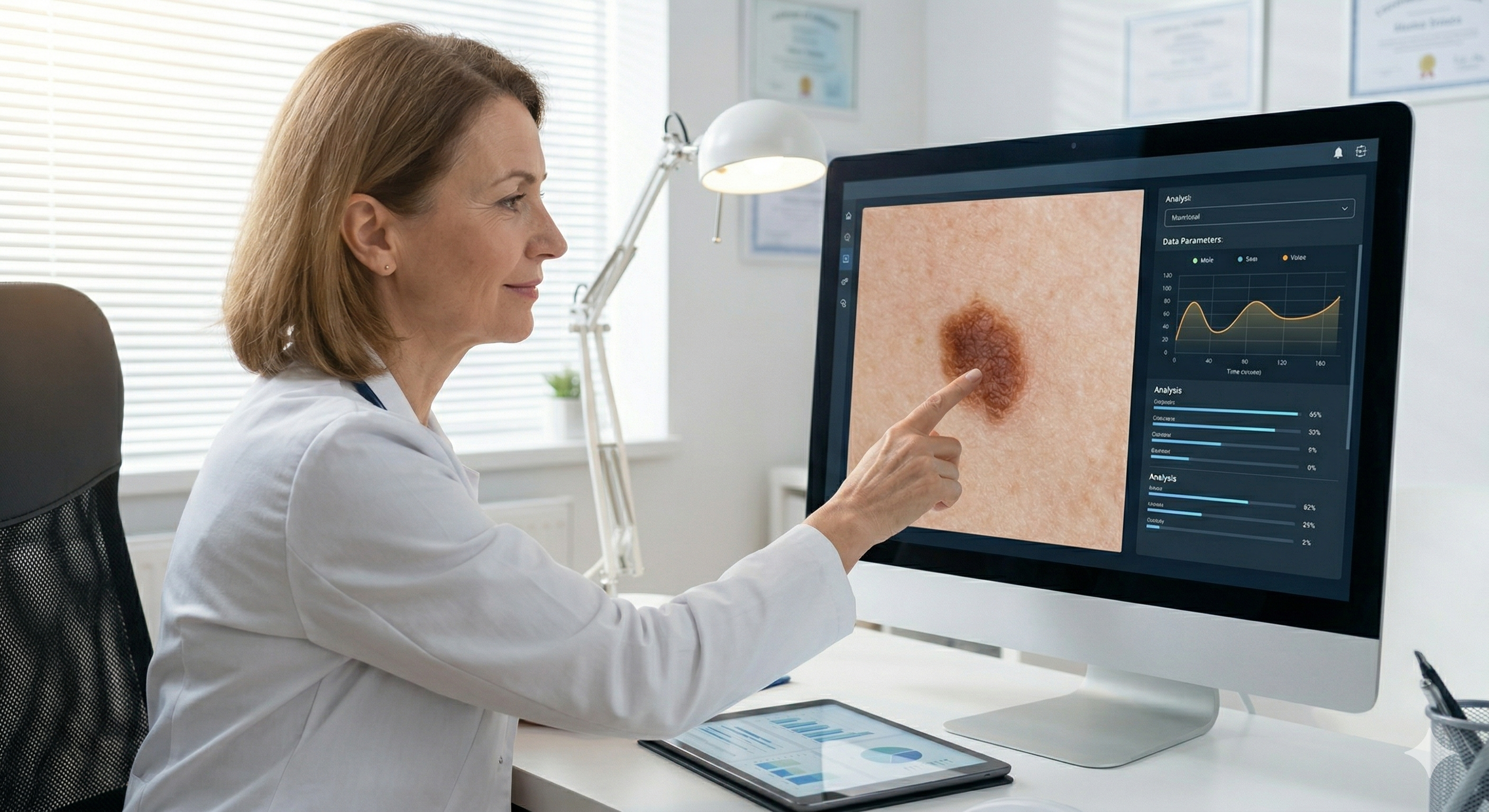

Most clinics don't fail at teledermatology because the medicine is hard. They fail because the tool they picked was built for generic video calls, not for skin.
Dermatology is a visual specialty. The software you choose decides whether you receive a blurry selfie with no history, or a structured case with standardized photos, a completed questionnaire, and everything you need to assess it in minutes. This guide covers what to evaluate before committing, and the questions a vendor should be able to answer.
Start with the workflow, not the feature list
Before comparing products, write down how a case should move through your clinic:
- Who receives a new patient submission, and how quickly must it be reviewed?
- Which cases can be handled asynchronously, and which need a live conversation or an in-person visit?
- Who documents the consultation, and where does that record live?
- How does the patient pay, and at what point?
A good platform maps onto this flow. If you find yourself redesigning the clinic around the software, it's the wrong software. New to the model? Start with what teledermatology is and how clinics use it, then come back to the checklist.
Eight things worth evaluating
1. Structured patient intake
This is the single biggest quality difference between platforms. Free-form email produces incomplete cases; a structured intake collects the history, duration, prior care, and consent before the case ever reaches a doctor. Ask to see the actual questionnaire a patient fills in. If it isn't dermatology-specific, everything downstream gets slower.
2. Photo handling
Look for guided photo capture (angles, distance, lighting hints), support for several images per case, and side-by-side comparison across follow-ups. Image quality at intake determines how many cases you can safely handle remotely instead of calling the patient in.
3. Documentation and audit trail
Every consultation should produce a structured, timestamped record: what was submitted, who reviewed it, what was concluded and communicated. You should be able to export your records at any time. If the vendor can't show an audit trail, assume there isn't one.
4. GDPR and data residency
Clinical photos are health data, a special category under Article 9 of the GDPR. That means you need EU hosting or an equivalent transfer mechanism, a signed data processing agreement, defined retention periods, and a way to answer patient access requests. "We are GDPR-compliant" on a pricing page is a claim, not evidence; the agreement is the evidence.
5. Patient communication
Follow-up questions belong inside the platform, attached to the case. Email threads and phone notes fragment the record; secure in-platform messaging keeps the full exchange in one place, which also protects the doctor.
6. Scheduling and payments
Prepayment at booking is one of the simplest levers against no-shows. Check that the platform handles online payment, refunds for cancelled cases, and receipts, without a separate invoicing tool.
7. Multi-doctor support
If more than one dermatologist will work in the system, look at case assignment, workload visibility, and per-doctor reporting. Solo practices should check the opposite: that the platform doesn't price them as if they were a hospital.
8. Pricing model
Per-consultation pricing keeps a low-volume start profitable; per-seat subscriptions reward high volume. Model both against your realistic first six months, and ask what happens to your records and patient relationships if you leave.
Red flags
- A generic telehealth tool with no dermatology-specific intake or photo flow
- Patient photos arriving by email or consumer messaging apps
- No export of your own records
- No audit trail of who reviewed and responded to a case
- "Compliance" claims without a signed data processing agreement
Six questions to ask a vendor
- Where is patient data hosted, and under which data processing agreement?
- Can we export all records and images if we leave? In what format?
- What does onboarding involve, and how long until the first real case?
- How does the platform guide patients to submit usable photos?
- What happens when a remote case turns out to need an in-person visit?
- How does pricing change as consultation volume grows?
Pilot before you commit
Run 20–30 real cases through the platform with two doctors before signing anything long-term. Measure three numbers: time per case, patient completion rate (how many started submissions actually reach a doctor), and how often you fall back to email or phone. Those three tell you more than any demo.
iDerma is built for exactly this evaluation: dermatology-specific intake, structured photo submissions, documentation, and secure patient communication in one system. Browse the rest of our teledermatology guides, or take the checklist above into a trial and see how the numbers come out.